|
Danish Audio ConnecT CT1 Audio
Attenuator
Reviewed by Fred
Gloeckler
Danish Audio ConnecT Ltd., Rm. 1501/3 Ban Chang
Glas Haus Bldg., 1 Sukhumvit Road Soi 25, Bangkok 10110, Thailand; (+66 2)
260 6072, FAX (+66 2) 260 6071, E-mail: vifadact@loxinfo.co.th, website:
www.dact.com. Prices: CT1 mono attenuators, US $105; CT1 stereo
attenuators, US $138.50; CT2 stereo attenuators, US
$126.20.
The Danish Audio ConnecT (DACT)
CT1 Audio Attenuator is a compact, 24-step switched attenuator. It uses
surface mount (SMT) resistors In a series configuration and is
available in one (mono unbalanced), two (stereo unbalanced or mono
balanced), and four (stereo balanced or quad unbalanced) deck
configurations (Photo 1).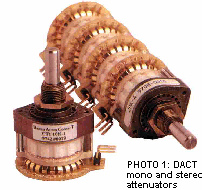
It offers standard
controls with total resistances of 10, 20, 50 and 100kOhm. Custom versions
will be considered. The nominal attenuation at each of the 24 steps is: 0,
-2, -4, -6, -8, -10, -12, -14, -16, -18, -20, -22, -24, -26, -28, -30,
-32, -34, -38, -42, -46, -50, -60 and -infinite dB.
The SMT resistors
are soldered to a circuit board, which, in turn, is soldered directly to
the switch deck pins. The layout is very compact, and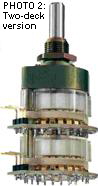 is said to minimize inductance and
stray capacitance. Both the circuit board and switch contacts are
gold-plated. The switch source appears to be ELMA. is said to minimize inductance and
stray capacitance. Both the circuit board and switch contacts are
gold-plated. The switch source appears to be ELMA.
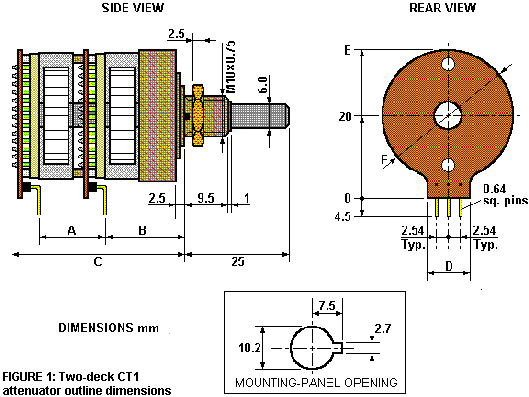
Figure 1
shows the outline dimensions of the two-deck version (also see
Photo 2). The front of the switch has a locating tab that fits in
the notch in the mounting-panel hole. The header pins allow you to make
connections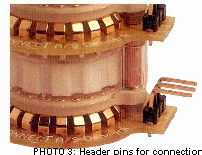 by hardwire, a header socket,
soldering to a circuit board, or, I suppose, a wirewrap (Photo 3).
The CT1 takes up little panel space and is suited for
"slim-line"enclosures that can't accommodate larger switches or
potentiometers. Danish Audio ConnecT's model CT2 (not tested) is slightly
more compact. by hardwire, a header socket,
soldering to a circuit board, or, I suppose, a wirewrap (Photo 3).
The CT1 takes up little panel space and is suited for
"slim-line"enclosures that can't accommodate larger switches or
potentiometers. Danish Audio ConnecT's model CT2 (not tested) is slightly
more compact.
The switch has a positive mechanical detent at each step.
While the turning torque is light, the detents can be felt and heard. The
6mm-diameter shaft accommodates knobs with standard 0.25" shaft holes. If
panel space is at a premium, you can use a relatively small-diameter knob
and still turn the shaft without using excessive force.
Danish Audio
ConnecT has a comprehensive data sheet for the CT1. Key electrical
characteristics are listed in Table 1. You can find more
specifications on the DACT website.
My shop isn't equipped to confirm
many of the electrical specifications. I checked attenuation accuracy,
channel balance, frequency response, and channel separation with the
outputs of a 20kOhm stereo CT1 feeding unity-gain buffers.
This setup
simulates the loading an attenuator might see in real life. The CT1 was
mounted in an aluminum box with its inputs connected to the input jacks
via shielded cable. The attenuator outputs were connected to
|
TABLE
1: KEY ELECTRICAL CHARACTERISTICS |
|
Parameter |
Value |
|
Total
resistance accuracy (new) |
0.1% |
|
DC
attenuation accuracy (new) |
±0.05dB |
|
DC
matching accuracy (tracking) (2 wafers) |
±0.05dB |
|
Contact
resistance (new) |
Max.
0.01Ohm |
|
Contact
capacitance (adjacent contacts) |
1pF |
|
Series
inductance (10kOhm version, pin 1 to 3) |
Max.
0.2µH |
|
Bandwidth
(10kOhm version, A=-6dB, deltaA=-3dB) |
50MHz |
|
Noise
voltage (10kOhm version, pin 1 to 3) |
12.8nV/sqrt(Hz) |
|
Total
harmonic distortion (A=-6dB, f=1kHz) |
Max.
0.0001% | | the
inputs of a pair of Borbely tape buffers1 by short, unshielded
wires. The buffers isolate the attenuator from the loading effects of
cables and test equipment and have a 1MOhm input resistance.
Measurements
Measurements were made with
a Fluke 8050A digital multimeter² using the Morrey version of a
Heath IG-18 audio generator as a signal generator³. In addition to
measuring the control resistance, I measured attenuation for each control
step at frequencies of 1, 10, 20, 50, and 100kHz using the relative
measurement capability of the 8050A. I then analyzed the measurements to
extract attenuation, channel-balance, and frequency-response
errors.
The total resistance errors for the two channels were -0.1% and
-0.075%, which meet the tight specifications.
Because the CT1's
performance is at or better than my instrumentation's
measurement capability, I debated how to present the results, or even,
whether to present them. I finally decided to just list the attenuation,
channel balance, and frequency-response errors tabulated in table
2.
|
TABLE 2: CT1 ATTENUATION ERROR, CHANNEL
BALANCE, AND FREQUENCY RESPONSE |
|
Nom. atten . (-dB) |
Attenuatio n Error
(dB) |
Channel Balance
(dB) |
Frequency Response Error
(dB) |
|
Front |
Rear |
(Rear - Front) |
Front Deck |
Rear deck |
|
1kHz |
1kHz |
1kHz |
10 kHz |
20 kHz |
50 kHz |
100 kHz |
10 kHz |
20 kHz |
50 kHz |
100 kHz |
10 kHz |
20 kHz |
50 kHz |
100 kHz |
|
0 |
0.00 |
0.00 |
0.00 |
0.00 |
0.00 |
0.00 |
0.00 |
0.00 |
0.00 |
0.00 |
0.00 |
0.00 |
0.00 |
0.00 |
0.00 |
|
-2 |
0.00 |
-0.01 |
-0.01 |
0.00 |
0.01 |
0.00 |
0.03 |
0.00 |
-0.01 |
-0.01 |
-0.02 |
0.01 |
0.01 |
0.00 |
0.02 |
|
-4 |
0.01 |
0.01 |
0.00 |
0.00 |
0.01 |
0.01 |
0.05 |
0.00 |
0.00 |
-0.01 |
-0.04 |
0.00 |
0.01 |
0.00 |
0.01 |
|
-6 |
-0.01 |
-0.01 |
0.00 |
-0.01 |
0.01 |
0.03 |
0.04 |
0.01 |
0.00 |
0.00 |
-0.02 |
0.00 |
0.01 |
0.03 |
0.02 |
|
-8 |
0.01 |
0.00 |
-0.01 |
-0.01 |
0.00 |
0.03 |
0.04 |
0.00 |
-0.01 |
-0.01 |
0.00 |
0.00 |
0.00 |
0.03 |
0.05 |
|
-10 |
-0.02 |
-0.02 |
0.00 |
-0.01 |
0.01 |
0.03 |
0.04 |
0.01 |
0.00 |
0.00 |
0.02 |
0.00 |
0.01 |
0.03 |
0.06 |
|
-12 |
-0.04 |
-0.04 |
0.00 |
-0.01 |
0.01 |
0.02 |
0.03 |
0.01 |
-0.01 |
0.01 |
0.05 |
0.00 |
0.00 |
0.03 |
0.08 |
|
-14 |
-0.02 |
-0.02 |
0.00 |
-0.01 |
0.01 |
0.02 |
0.02 |
0.00 |
-0.01 |
0.01 |
0.08 |
-0.01 |
0.00 |
0.03 |
0.10 |
|
-16 |
-0.04 |
-0.04 |
0.00 |
-0.01 |
0.01 |
0.01 |
0.01 |
-0.01 |
-0.02 |
0.00 |
0.08 |
-0.02 |
-0.01 |
0.01 |
0.09 |
|
-18 |
-0.05 |
-0.06 |
-0.01 |
-0.01 |
0.01 |
0.02 |
0.01 |
-0.01 |
-0.03 |
-0.01 |
0.09 |
-0.01 |
-0.01 |
0.02 |
0.11 |
|
-20 |
0.01 |
0.01 |
0.00 |
0.00 |
0.01 |
0.02 |
0.02 |
0.01 |
0.00 |
0.01 |
0.01 |
0.01 |
0.01 |
0.03 |
0.03 |
|
-22 |
0.00 |
-0.01 |
-0.01 |
0.01 |
0.00 |
0.02 |
0.01 |
-0.01 |
0.00 |
0.01 |
0.02 |
0.01 |
0.01 |
0.04 |
0.04 |
|
-24 |
0.01 |
0.01 |
0.00 |
0.01 |
0.01 |
0.02 |
0.01 |
-0.01 |
0.00 |
0.02 |
0.03 |
0.00 |
0.01 |
0.04 |
0.04 |
|
-26 |
0.00 |
0.00 |
0.00 |
0.01 |
0.01 |
0.02 |
0.01 |
-0.01 |
0.00 |
0.02 |
0.04 |
0.00 |
0.01 |
0.04 |
0.05 |
|
-28 |
0.02 |
0.01 |
-0.01 |
0.01 |
0.02 |
0.02 |
0.01 |
-0.01 |
-0.01 |
0.01 |
0.06 |
0.01 |
0.02 |
0.04 |
0.08 |
|
-30 |
-0.01 |
0.00 |
0.01 |
0.01 |
0.01 |
0.02 |
0.02 |
-0.01 |
0.00 |
0.02 |
0.06 |
-0.01 |
0.00 |
0.03 |
0.07 |
|
-32 |
-0.05 |
-0.05 |
0.00 |
0.01 |
0.01 |
0.02 |
0.01 |
0.00 |
0.00 |
0.02 |
0.08 |
0.01 |
0.01 |
0.04 |
0.09 |
|
-34 |
-0.02 |
-0.03 |
-0.01 |
0.00 |
0.00 |
0.01 |
0.00 |
-0.01 |
-0.01 |
0.01 |
0.09 |
0.00 |
0.00 |
0.03 |
0.10 |
|
-38 |
-0.02 |
-0.03 |
-0.01 |
-0.01 |
0.00 |
0.00 |
0.00 |
-0.01 |
-0.03 |
0.00 |
0.08 |
-0.01 |
-0.02 |
0.01 |
0.09 |
|
-42 |
0.07 |
0.05 |
-0.02 |
-0.01 |
0.01 |
0.00 |
0.00 |
0.01 |
0.01 |
0.16 |
0.58 |
0.02 |
0.04 |
0.18 |
0.60 |
|
-46 |
0.07 |
0.04 |
-0.03 |
-0.01 |
0.00 |
0.00 |
0.00 |
0.00 |
0.00 |
0.15 |
0.59 |
0.02 |
0.03 |
0.18 |
0.62 |
|
-50 |
0.02 |
0.00 |
-0.02 |
-0.01 |
-0.01 |
-0.01 |
-0.01 |
0.00 |
0.01 |
0.16 |
0.63 |
0.01 |
0.02 |
0.17 |
0.64 |
|
-60 |
-0.06 |
-0.08 |
-0.02 |
-0.02 |
0.01 |
0.01 |
0.01 |
-0.01 |
-0.03 |
0.13 |
0.64 |
-0.01 |
0.00 |
0.14 |
0.67 | |
At the specified level of
attenuation accuracy, the loading of a 1MOhm resistor on a 20kOhm control
is significant. Therefore, I compensated attenuation measurements for the
buffer input resistance. Most of the attenuation errors at 1kHz were well
within the ±0.05dB limit, specified at DC. Those that exceeded the limit I
attribute to measurement error rather than a deficiency in the CT1.
In
any case, the audible result of attenuation error is an incorrect setting
of the system output level. Step size and finite loading of the attenuator
are likely to dominate the ability to establish the desired level, rather
than the insignificant errors indicated by the measurements.
The
channel balance (tracking between the two decks) was well within the
specified ±0.05dB at frequencies up to 50kHz. You should not experience
any "image wander" when the control position is changed.
The
frequency-response errors at 10, 20, 50, and 100kHz are relative to the
output at 1kHz and are inconsequential throughout the audible range. The
larger errors at higher frequencies and high attenuation definitely result
from the 8050A's measurement limitations rather than any deficiencies in
the CT1.
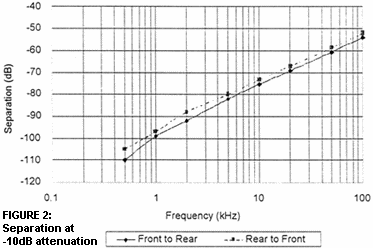
Figure
2 shows the separation, relative to the output of the driven
channel, at
-10dB attenuation with approximately 1.5V RMS out of the
driven channel. The nondriven input was terminated with a 150Ohm resistor
to simulate source output resistance. The least separation occurred around
-10dB attenuation.
Some experimentation indicated that application of
shielding might improve the separation figures a couple of dB. Since the
results were excellent without shielding, I didn't pursue it further. If
you take care with the layout of the ancillary circuitry, the CT1
shouldn't audibly degrade separation.
Listening Tests
For
listening tests, I mounted the CT1 in an aluminum enclosure and directly
wired it to gold-plated pairs of RCA-style input and output jacks. The
buffers used for the instrumented tests were not used except for a
brief listen. I used a 20kOhm Alps "black" pot, which was several years
old, and my "passive preamp" for comparison. The Alps pot was configured
the same as the CT1.
The "passive preamp" has 32-step, dual-concentric
series attenuator; a 20dB "mute" switch; and extensive input and
tape-recorder selection switching. The dual-concentric control was built a
number of years ago with 2% carbon-film resistors and Shallco silver
contact switches. The "passive preamp" jacks are not gold-plated.
I
auditioned commercial CDs and master DATs of some of my own recordings.
The system front end consisted of a Rotel RCD-955AX CD player or TASCAM
DA-30 MkII DAT recorder, used as transports, feeding an Assemblage DAC
1.5. Since my DATs were recorded middle-side (M-S) with a crossed
figure-8-pattern stereo microphone, the DAC fed a homebrewed M-S
dematrixer only for the tapes. A partially "pooged" Hafler DH200 amplifier
fed IMF Studio III-B speakers. While not state of the art, the system has
a reasonably natural sound.
Since it had the coarsest level of
resolution, I first chose the listening level using the CT1. The other two
controls were then set to give the same level out of the amplifier at
300Hz. Since the "passive preamp" was designed for the load of the
amplifier and the CT1 wasn't, the output was 0.17dB lower with the
"passive preamp" at the closest setting.
The Alps pot wasn't
competitive with either the CT1 or the "passive preamp".
A DAT of
Stravinsky's Pulcinella Suite provides a wide range of instrument
combinations and colors. The Alps pot imparted a significantly colored,
"hollow" sound to the ensemble, with no sense of "air".
A CD of Maurice
Durufle´s organ music (Hyperion CDA66368) has a great dynamic range, a
variety of organ colors, and some wind and "room" sounds. In the first
cut, there is a quiet section with a mixture adding brightness. With the
Alps pot, I couldn't hear the fundamentals, and the mixture sounded pretty
much of a hash. There wasn't much sense of the room or the wind noises at
the end of the cut. I didn't invest more time with the Alps
pot.
Natural Sounds
With
the Stravinsky, the CT1 had very natural instrument sounds with a good
sense of space. The harmonics were well integrated with the fundamentals.
In comparison, the "passive preamp" had a somewhat darker sound, with less
sense of the room. The sound was bound more to the speakers, and the
harmonics were less well integrated. With the Durufle´ selection, there
was clearer definition of the organ's voices, better sense of the space
(and wind noises), and better integration of fundamentals and harmonics
with the CT1.
A CD by the BBC Singers (BBC MM125) revealed some
interesting contrasts. In Bach's Der Geist Hilft (BWV 226), the
singers were clearer, and the continuo organ more distinct and rhythmic
with the CT1. This cut has a lot of what I call "splatter echo", and I
surmise the recording venue, St. Paul's Church, Knightsbridge, London, has
hard surfaces. Anyway, the "splatters" were more distinct with the CT1 and
more in keeping with my experience in similar acoustics.
In a piece by
Max Reger, the CT1's sound was less dark and more natural. In the loud
parts, the chorus sounded more intense and involved than with the "passive
preamp." In some songs by Mendelssohn, the micro dynamics were more
evident and the choir less bound to the speakers when the CT1 was
used.
In a recording of our church choir with organ and string
orchestra, more individual singers were recognizable and there was better
separation of voices and instruments through the CT1. I could go on but,
you get the picture - the CT1 was simply clearer than the "passive
preamp". This wasn't accomplished by the addition of artificial detail.
The components of the sound were better integrated and closer to
life.
In comparison, the "passive preamp" interjected a slight brownish
haze that obscured detail. By the way, when the buffers were added to the
equation, the sound was excessively bright and unattractive. It
reemphasized the reasons I haven't had a line stage in my main system for
25 years.
With its clear, natural sound, superb specifications, compact
size, and high quality standard, I highly recommend the CT1 for
consideration when you need a volume control. After listening to it, I'm
compelled to upgrade my system. Now, if they'd just provide a
high-resolution means to adjust balance...
|
References
1.
Erno BorbeIy, "The Borbely Preamp, Part II," TAA 1/86.
2.
Fred Gloeckler, "Fluke 805OA Digital Multimeter," TAA
1/82.
3. Walter T. Morrey, "Morreys Super Oscillator,"
TAA/4/75
4. Walt Jung and Dick Marsh, "POOGE-2, A Mod
Symphony for Your Hafler DH2OO or Other Power Amplifiers," TAA
4/81. | |
Manufacturer's
response:
We wish to thank Audio Electronics and Fred
Gloeckler for the thorough review of our CT1 stepped audio attenuator. One
detail to add is that the CT1 is now also available in 250kOhm and our CT2
attenuator is also available in 500kOhm. Since the review appeared, we
also have changed our policy to include in our prices the shipping costs
worldwide. The new prices (in US dollars) are: CT1 mono, $113; CT1 stereo,
$154; CT1 balanced stereo, $284.50; CT2 stereo, $136; and CT2 A/V audio
6-channels (new item), $319.
We appreciate the care that Mr. Gloeckler
has taken when considering the measurements and their validity. The CT1
matches most test equipment on many parameters, and it is of course
important to evaluate the measurements' validity. Well done!
We have
also concluded, like Mr. Gloeckler, that the sonic performance of a
high-quality passive volume control is often better than most active
preamplifiers. This may not come as a surprise, since all components add
their own signatures to the sound, and only the finest preamplifiers are
nearly "inaudible."
On the other hand, connecting, for example, a CD
player directly to the power amplifier with only a passive volume control
in between has its own limitations. Some important impedance issues need
to be considered. At our web site there is an application note describing
this topic.
Both passive and active preamplifiers require a
high-quality volume control and we are satisfied that Mr. Gloeckler's
listening tests document that there are significant audible differences
between standard volume controls and the more specialized controls.
ln
his review, Fred Gloeckler caIls for a high-resolution balance control. We
will not disappoint him. We are now working on a stepped balance control
with very high resolution.
Finally, we would like to mention that DACT
has recently appointed a local representative in the US: Aloha Audio,
phone/fax (808)-585-8911.
Allan
Isaksen
Danish Audio ConnecT, Ltd. |